Alright, let’s cut to the chase – if you’re running a production line, mining site, warehouse, or even a food processing plant, your PVC conveyor belt is basically the unsung hero keeping your operations moving. And if you’ve ever spotted a tear in one? That’s not just a cosmetic blip. As a PVC conveyor belt supplier, I’ve fielded so many panicked calls when a belt tears on the job, and most folks have no clue how quickly that tiny tear can snowball into a full-blown headache (or worse, a costly shutdown). Let’s break down what actually happens when tears hit a PVC belt, how they tank performance, and what we do as a supplier to help you head this stuff off before it derails your day. PVC Conveyor Belt
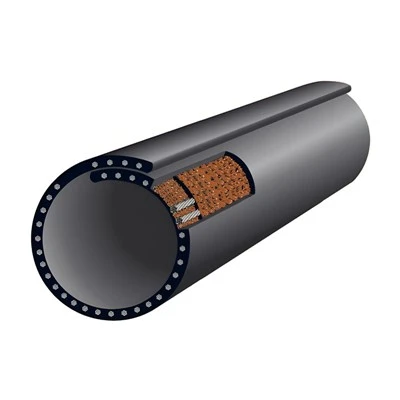
First off, let’s get real about what a tear in a PVC conveyor belt even is. It’s not just a nick – a tear is a linear or irregular split in the belt’s structure, right? Unlike scuffs or minor abrasions that only scratch the surface, a tear pierces through the PVC top cover, the polyester or nylon carcass (the tough woven core that holds the belt together), and sometimes even the bottom cover. I see this all the time: a big metal part falls off a forklift, rocks shift in a mining hopper, or a package gets jammed in the rollers, and boom – that’s a tear, often fast enough you barely have time to hit the emergency stop.
Now, let’s talk performance hits, and I’m not just talking about “the belt breaks.” First up, load handling goes to garbage real fast. PVC belts are designed to carry uniform loads, spread evenly across their width. A tear messes that up immediately. Let’s say you’re hauling 50lb bags of grain on a belt – if there’s a 6-inch tear running right down the middle, those bags aren’t going to sit tight. They’ll slide into the tear, catch on the edges, and either tip over or get ripped open, spilling product everywhere. Spilled product isn’t just waste – if you’re in food processing, that cross-contamination risk is a whole other level, and if you’re in mining, that spilled ore is money you’re leaving on the table, plus a slip hazard for your crew. I had a customer last year, a small packaging plant, ignore a 4-inch tear because they thought they could “run it until the next shift change.” By the time they stopped, they’d spilled $1,200 worth of snack food, and had to shut down for 3 hours to clean it all up. That’s the kind of avoidable cost tears bring.
Next, there’s structural integrity taking a nosedive, and this is where the long-term damage comes in. The PVC top cover is there to protect the carcass, which is the belt’s backbone. When you tear through that, moisture, dust, and grit get in there. PVC is a plastic, so it’s water-resistant, but the woven core isn’t. If you’re running a belt outdoors in rain, or a metal stamping plant with all that fine metal dust, that stuff seeps into the tear, and over time, it wears down the core fibers. Those fibers start to fray, and the tear gets bigger – not just along the length, but across the width, turning a 6-inch tear into a 2-foot split in a matter of weeks. That’s when you’re not just dealing with performance; you’re dealing with a full belt replacement before you’re ready. I also see tears cause edge damage. A tear at the edge of the belt will pull the adjacent material away from the belt’s edge, so the belt starts to track off the rollers. Tracking issues mean more friction, more wear on the rollers, and eventually, the belt might rub against the frame, causing even more tears. It’s a vicious cycle.
Then there’s the downtime factor, and let’s be honest – downtime is the killer for any operation. When a healthy PVC belt fails, you’re looking at 2-8 hours for a replacement, depending on the size. But when there’s a tear? If it’s in the middle of a 12-hour night shift, you might be waiting for emergency repairs, or for a new belt to be delivered, because trying to run a torn belt is just asking for a bigger failure. I’ve had clients call us at 2 a.m. because a tear took out their entire assembly line, and they need a rush replacement. That’s not cheap, and it’s not just the belt cost – it’s the lost production. For a manufacturing plant making parts that go to a major auto company, every hour of downtime costs them $15,000. Multiply that by 8 hours, and that’s $120k down the drain, all because of a tear they could’ve planned for, or even prevented with regular checks.
Wait, but let’s not paint all tears as the same. Not all tears hit performance equally, right? A tiny 1-inch nick from a bolt, caught early, won’t tank performance. It’s when tears are left unrepaired, or they’re larger than 3 inches, or they’re running along the carcass, that the real damage starts. I once had a customer who thought a 2-inch tear on a belt moving pallets was “no big deal” because it was on the underside, not the top. Wrong. That tear was rubbing against the pulley every time the belt looped around, so it got bigger every day, until it ripped all the way across the belt, and snapped while they were hauling a 2,000lb pallet. That’s when it becomes a safety hazard too – the pallet fell, no one got hurt, but it could’ve been way worse. OSHA isn’t messing around with conveyor belt safety, either; a torn belt that fails can lead to trips, falls, or being struck by falling product, so that’s another layer of performance impact: safety compliance. If your belt has a tear, you’re risking a citation, or worse, an incident that shuts you down completely.
Now, as a PVC conveyor belt supplier, I’m not just here to tell you how bad tears are – I’m here to give you real, actionable stuff we do to mitigate this. First, we build our belts with specific materials to resist tears. We use high-tensile polyester carcasses that are woven to handle sharp impacts, and the PVC covers are formulated to be tear-resistant, not just scratch-resistant. We run tests in-house – we simulate rock falls, sharp metal edges, heavy loads, to make sure our belts don’t tear as easily as the cheap ones you might get from a random supplier. But even the best belts will tear if you don’t maintain them. We recommend monthly inspections – not just quick visual checks, but looking for small tears along edges, where pulleys rub, and where loads are dropped. Catching a 1-inch tear and patching it immediately is way cheaper than dealing with a 2-foot split. We also offer custom guides, like edge protectors and impact bars, to reduce the chance of tears from falling loads, which is the number one cause of tears in PVC belts.
Let me also clear up a common myth: some folks think “if I just run the belt slower, the tear won’t get worse.” Nope, that doesn’t work. The tear is still there, the load is still catching in it, and as the belt moves, the edges of the tear keep rubbing against each other or the rollers, making it bigger, even at half speed. The only way to stop a tear from spreading is to repair it properly, or replace the belt before it fails.
So, let’s circle back to performance: tears don’t just ruin a belt – they ruin your production schedule, your bottom line, your safety records, and your peace of mind. If you’re noticing tears, or you want a belt that’s built to resist them in the first place, let’s chat. We can go over your specific application – whether you’re moving heavy rock, food products, pallets, whatever – and get you a PVC conveyor belt that fits your needs, plus a maintenance plan to catch issues before they become costly headaches. We don’t do one-size-fits-all here, because we know every operation is different, and your conveyor belt shouldn’t be an afterthought.
If you’re tired of dealing with tear-related downtime, or you just want to make sure your current setup is holding up, reach out. We can answer all your questions, give you a free inspection quote, or help you get a replacement belt that’s built to last. Don’t wait until that tiny tear becomes a full shutdown – let’s get this sorted now.
Profiled Conveyor Belt References
- "Conveyor Belt Damage: Causes, Prevention, and Repair." Industrial Conveyor Association, 2022.
- "PVC Conveyor Belt Performance Under Tear Loading Conditions." Journal of Materials Processing Technology, vol. 278, 2020, pp. 116521.
- Occupational Safety and Health Administration (OSHA). "Conveyor Safety Standards for General Industry," U.S. Department of Labor, 2021.
- "Tear Resistance in Polyvinyl Chloride (PVC) Conveyor Belts: Material Formulation Impacts." Journal of Industrial Textiles, vol. 49, no. 8, 2019, pp. 987-1005.
- Maintenance Best Practices for Material Handling Systems. Material Handling Industry (MHI), 2023.
Alumina Technology (Qingdao) New Materials Co., Ltd.
As one of the most professional pvc conveyor belt manufacturers and suppliers in China, we also support customized service. With abundant experience, we warmly welcome you to buy pvc conveyor belt for sale here and get quotation from our factory. For price consultation, contact us.
Address: No.448, Jiangshan South Road, Huangdao District, Qingdao City, Shandong Province
E-mail: Gloria.zhang@contitech.cn
WebSite: https://www.altechconveyorbelt.com/
